

 Six hours is an awful lot of time to be bobbing around aimlessly and alone in the vast expanse of the Pacific Ocean, but that’s exactly what happened to an Australian scuba diver on Tuesday, July 5th 2016. He was with a group of divers at Althea Wreck, about 35 nautical miles from the Bundaberg coast. 40 meters beneath the surface lies the wreckage of a trawler that sank in 1991 and now serves as a favorite spot for an array of marine life – including groupers, bull-rays, and trevally.
An enticing adventure for experienced divers.
Although the weather was quite fair that Tuesday, Jacob Childs and his group of divers suddenly found themselves struggling with a powerful undercurrent. At the point when he finally managed to surface alongside the boat, Childs discovered, much to his dismay, that the tagline was out of his reach. Within a few short moments, the powerful current put a distance of miles between him and the boat.
The absence of Childs from the group was noticed only a bit later, at which point the Australian coast guard launched a massive search for him. Like searching for a needle in a haystack, neither the search boats nor the circling helicopters were able to locate Childs, who must have been awfully frustrated as he could see the helicopter with no problem. Childs had a camera with him and filmed what he thought was going to be his last message. His words were, more or less, “Sundown is coming and then they aren’t going to be able to do a thing…I guess that’s a wrap for old Jakey.”
Amazingly, Childs stayed pretty calm throughout his ordeal. According to Sergeant Rob Jorna – who headed the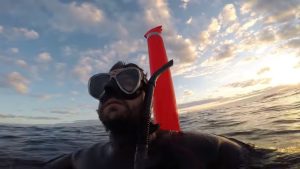 search operation – it was precisely that calm, born of Childs’ extensive sea experience, that was crucial to his being rescued. “He knew what to do,” said Jorna, “he didn’t panic and he did all the right things.” Childs’ wetsuit kept him warm, his flotation device prevented him from getting overcome from exhaustion, and its large orange appendage is what enabled the helicopter crew to eventually spot him. Even the thought of spending the night floating solo in the Pacific didn’t particularly faze Childs. In his words, “If you’ve got to do it, you’ve got to do it.”
This item brings to mind another story of survival at sea, albeit one which took place about 1,800 years earlier and did not involve an experienced scuba diver. Within the general discussion of of agunos, the Gemara address drowning situations. Seeing someone get lost at sea – if you cannot see the borders thereof from all sides – is not sufficient grounds to assume he is dead and allow his wife to remarry. In support of this assertion, the Maseches Yevamos 121a records a fascinating anecdote related by Rabban Gamliel.
One time, when I was in the midst of a sea journey, I saw another boat that collapsed and sank into the ocean. My distress over the sight was exceedingly acute for none other than Rabi Akiva was on board that boat! However, when I returned to terra firma, he appeared and participated in the halachik discourse! I said to him, ‘My son, who extracted you from the water?!’
 ‘A wooden board happened my way,’ answered Rabi Akiva, ‘and every time a wave washed over me, I submissively bent my head down.’
Then the Gemara adds a profound, homiletic note.
From this incident – say the Sages – we see that if wicked people come upon a person, he should submissively nod his head to them.
Rabi Akiva was bobbing along in the open ocean with nothing more than a piece of driftwood to serve as his flotation device, and not an iota of experience in sea-diving to inform his decisions in those fateful moments. One thing, though, he clearly had in abundance: tremendous wisdom. Despite his seemingly impossible situation, Rabi Akiva did not panic and did not give up hope.
And another thing Rabi Akiva did not do is try to fight the waves!
Lifeguard training includes learning how to handle a drowning victim’s thrashing about. When a person panics he is liable to enter a completely irrational “fight or flight mode” that can cause him to desperately fight against even his rescuer! And if that’s true of a rescuer, it is that much more true when it comes to waves, riptides, and whirlpools. When a person is gripped with the panic of feeling like a goner, the fatal kneejerk reaction can be to try to fight against the force that feels like it is pulling one into the abyss.
Rabi Akiva demonstrated for us, though, that it is utterly futile and even counterproductive to do so. The waves and currents are far, far too powerful. The struggler will rapidly tire, and the ocean’s energy will completely overtake him. Rabi Akiva showed us that the way to handle the waves of the ocean, and also the wave’s of life’s insurmountable hardships, is to submissively nod one’s head to them. Rabi Akiva’s wisdom teaces us to recognize when battling a situation is futile and not try to fight it. Accept the situation for what it is, and in the end you will, with Hashem’s help, come out alive and well.